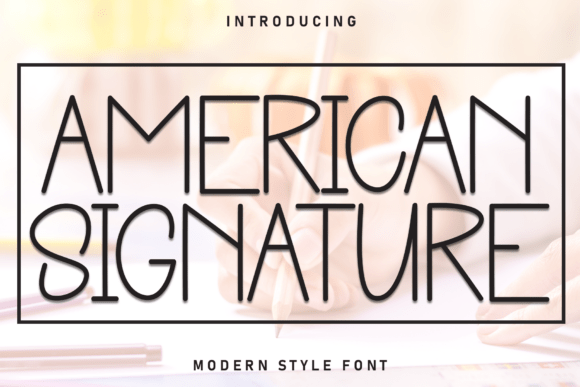
American Signature 1: A Playful Handwritten Font for Joyful Design Projects
When it comes to choosing the right typeface for creative design, the personality of the font can make or break the emotional tone of the final piece. American Signature 1 stands out as a distinctive handwritten display font that brings a sense of charm and lightheartedness to any project. Designed to evoke a friendly, approachable aesthetic, this font is especially effective in contexts where warmth and individuality are key.
At first glance, American Signature 1 captures attention with its soft, flowing strokes and slightly irregular character shapes. Unlike rigid, machine-like fonts, this typeface mimics natural handwriting, giving it a personal and intimate feel. It’s not meant to be precise or formal — instead, it embraces a whimsical, almost childlike energy that can enhance the emotional resonance of a design.
How American Signature 1 Stands Out
Many display fonts aim to be decorative or eye-catching, but American Signature 1 differentiates itself by focusing on approachability rather than boldness. It doesn’t shout for attention — it invites the viewer in with a gentle, familiar touch. This makes it especially effective for projects that benefit from a human, handcrafted feel rather than a polished, commercial look.
Compared to other handwritten fonts, American Signature 1 maintains a balance between legibility and stylization. Some script fonts can become difficult to read when used at smaller sizes or in longer blocks of text, but this font retains clarity while still offering expressive character. Its letterforms are designed with enough spacing and open shapes to ensure readability without sacrificing personality.
When to Use American Signature 1
This font excels in design contexts where warmth and friendliness are central themes. It’s particularly well-suited for:
- Wedding invitations and stationery
- Handmade greeting cards and personal correspondence
- Children’s book illustrations and educational materials
- Branding for small businesses with a cozy or boutique identity
- Social media graphics and digital illustrations that aim to feel personable
In each of these cases, the goal is to convey sincerity and individuality — something American Signature 1 achieves naturally. It works especially well when combined with soft color palettes, organic shapes, and minimalist layouts that let the font’s character shine.
Comparing American Signature 1 to Similar Fonts
There are many handwritten fonts available today, ranging from casual brush scripts to more structured cursive styles. American Signature 1 falls into the “playful but readable” category, making it a middle ground between overly stylized fonts and more utilitarian handwriting alternatives.
For example, brush script fonts often have dramatic strokes and high contrast, which can add drama but may also reduce readability. In contrast, American Signature 1 maintains a more even weight throughout, making it easier to read across different formats. On the other end of the spectrum, minimalist handwriting fonts can feel too plain or generic. American Signature 1 avoids that by incorporating subtle quirks and expressive elements that give each character a unique presence.
Understanding the Tradeoffs
While American Signature 1 has many strengths, it’s not a one-size-fits-all solution. Its playful nature makes it less suitable for formal or technical applications. For instance, legal documents, academic papers, or corporate branding typically require a more neutral and professional tone — something this font does not aim to provide.
Additionally, because of its stylistic flourishes, American Signature 1 may not scale well in all digital environments. While it looks great on print materials and high-resolution screens, it might appear less crisp on low-resolution displays or when used in small sizes without careful spacing adjustments.
Best Practices for Using American Signature 1
To get the most out of American Signature 1, designers should consider pairing it with complementary typefaces and visual elements. A good rule of thumb is to use it for headlines or short bursts of text rather than extended body copy. When used as a primary font in a design, it benefits from being paired with a clean, sans-serif font for contrast and balance.
Spacing is also crucial. Kerning and line spacing should be adjusted carefully to preserve the font’s readability and prevent letters from appearing crowded. Designers should also be mindful of background textures — a busy or dark background can detract from the font’s delicate nature.
Real-World Examples and Use Cases
Consider a local bakery launching a new line of artisanal cookies. Using American Signature 1 on product labels or packaging inserts would reinforce the brand’s handmade, small-batch identity. In contrast, a financial advisory firm would likely choose a more traditional serif or sans-serif font to convey professionalism and trust.
Another practical example is in wedding stationery. A couple planning a rustic or vintage-themed wedding might use American Signature 1 for their save-the-date cards or RSVP envelopes to add a personal, handwritten touch. Meanwhile, a modern minimalist wedding might opt for a cleaner, geometric font to match the overall aesthetic.
Is American Signature 1 the Right Choice for Your Project?
The decision to use American Signature 1 ultimately depends on the tone and purpose of the design. If you're aiming for a design that feels warm, personable, and a little whimsical, this font is an excellent choice. However, if your project requires a more formal, technical, or universally neutral appearance, you may want to explore alternative typefaces that better align with those goals.
Designers should also consider the audience. American Signature 1 appeals particularly well to younger audiences and those who appreciate handmade or indie aesthetics. It may not resonate as strongly with older demographics or in industries that prioritize tradition and formality.
Exploring Alternatives
If American Signature 1 doesn’t quite fit your needs, there are several other handwritten fonts that offer different levels of expression and legibility. Some alternatives might emphasize more structured handwriting, while others lean into bold, brush-style strokes. The key is to evaluate how each font supports the message you want to convey and how it performs across different media.
When evaluating options, it’s helpful to test fonts in real design mockups. Seeing how they look in context — with your chosen colors, layout, and imagery — can make a big difference in determining the right choice.